
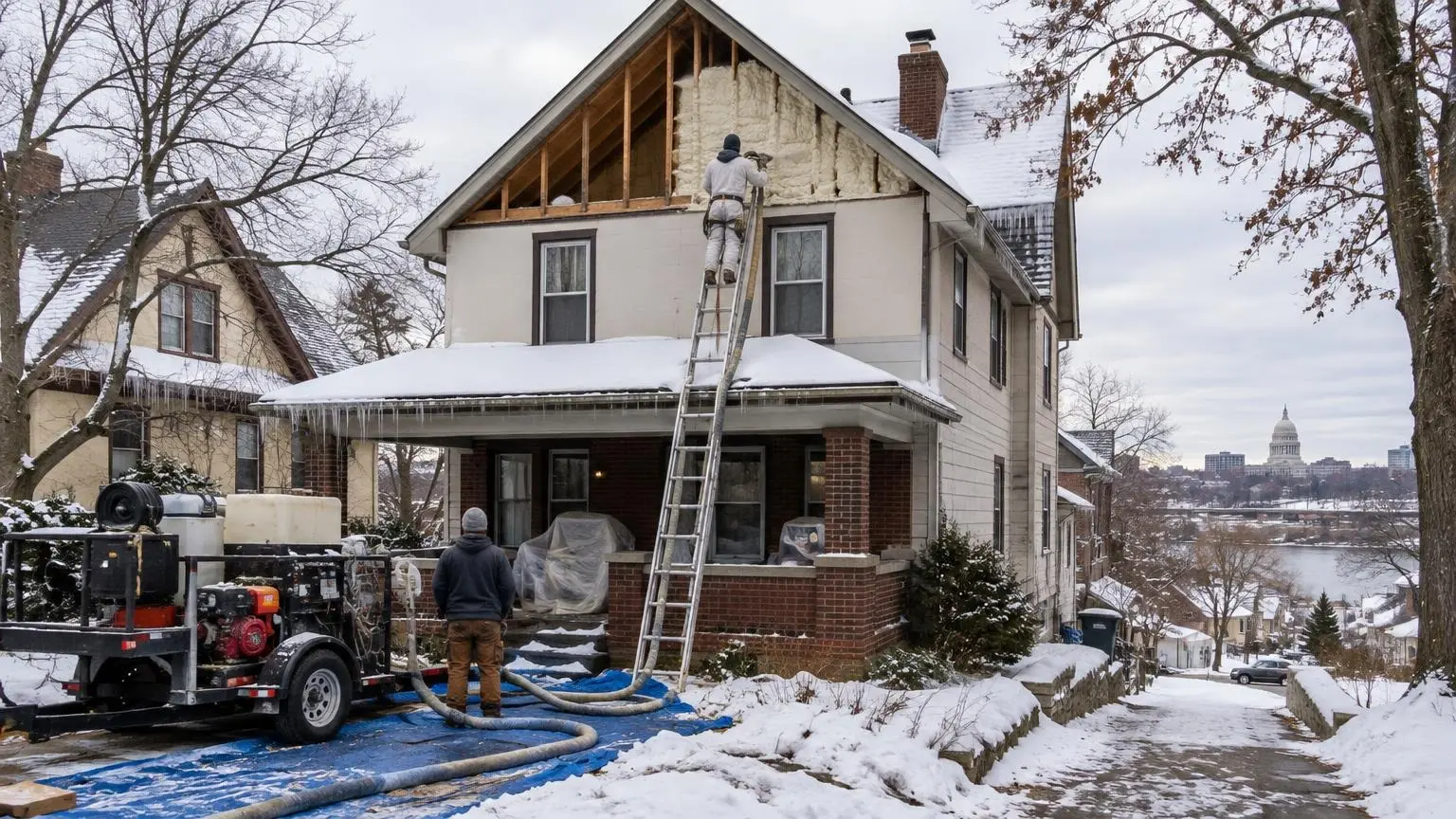
Drafty plaster walls?
Wall Insulation in Lansing, MI
Fill closed walls without tearing them out, or spray foam open ones.
- Free in-home estimates with measurements
- Itemized written quote: material, thickness and R-value per area
- Leaks, damp spots and old insulation checked before we cover anything
Insulating Walls in Older Lansing Homes
Wall insulation is often missing entirely in Lansing houses built before the 1950s, and roughly half of the city's homes date from before 1960. Plaster walls on balloon framing may have nothing in the cavities but air, and that air moves. You feel it as cold exterior walls, drafts at outlets and baseboards, and rooms that never warm up on the north side of the house.
Closed walls: dense-pack cellulose
The standard way to insulate a finished wall without removing it is dense-pack cellulose. We drill a small hole in each stud bay, from outside under the siding or from inside, and blow cellulose in at high density so it fills the cavity and resists settling. Dense-pack also slows air movement inside the wall. Holes are plugged and patched afterward. Regular spray foam cannot be used in closed walls because it expands too fast and can bow plaster or drywall.
Open walls: spray foam
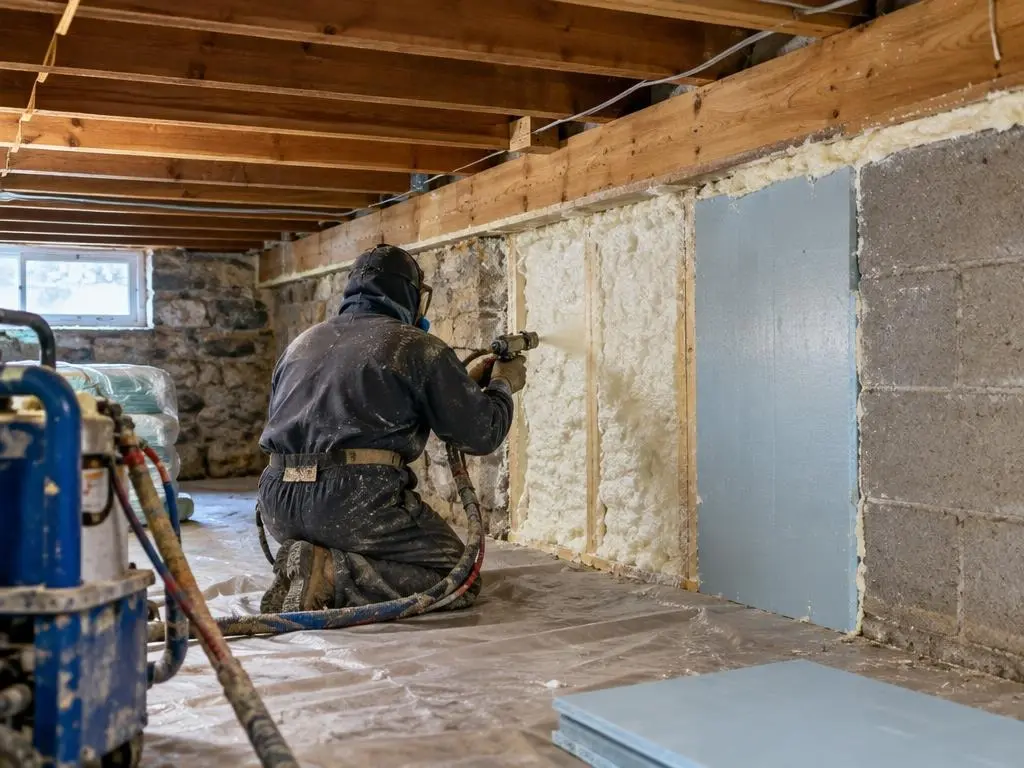
When walls are open for a remodel, addition or gut renovation, spray foam goes straight into the stud bays. Closed cell gives the most R-value per inch, which matters in 2x4 walls, and stiffens the wall. Open cell costs less and fills completely. Michigan's 2015-based code calls for R-20 cavity insulation, or R-13 plus R-5 continuous, in new Zone 5 walls.
What we check first
Before filling walls we look for knob-and-tube wiring, which should be evaluated by an electrician before insulation surrounds it, and for moisture problems like failed flashing or missing gutters that would wet new insulation. We also check whether walls have fire blocking, since balloon-frame cavities can run two stories.
When it pays
Wall insulation pays most in older homes with empty cavities, after the attic and basement leaks are handled. If walls already have some insulation, the gain is smaller and we will tell you so.
Wall Insulation Options
Matched to whether the wall is open or closed.
Dense-pack cellulose
Blown into closed stud bays through small holes, then patched.
Open-wall spray foam
Closed or open-cell foam in exposed stud bays during remodels and additions.
Kneewalls and bonus rooms
Insulating and sealing the short walls and floors around finished attic rooms.
Garage-to-house walls
Sealing and insulating the shared wall to keep cold and fumes out.
Additions and new construction
Foam or blown insulation in new framing to meet or beat code.
Published Wall Insulation Costs
| Job | Range and source |
|---|---|
| Spray foam, existing walls / new construction | $3.15 to $7.50 / $2.75 to $6.50 per sq ft (Fixr) |
| Spray foam, all exterior walls | $4,000 to $10,000 (HomeGuide) |
| Blown-in, exterior walls | $1,900 to $7,800, $1.10 to $3.70 per sq ft (HomeGuide); $2,000 to $4,000 (Fixr) |
| Dense-pack cellulose | $1.60 to $4.20 per sq ft (HomeGuide) |
| Fiberglass / cellulose, blown | $1.65 to $2.60 / $1.75 to $3.80 per sq ft (Fixr) |
National ranges from HomeGuide (spray foam 2026, blown-in November 2025) and Fixr (2025). Wall height, siding type, number of stud bays, patching and any wiring concerns change the cost. We count your bays and write up the price, and the written estimate is what you pay.
How a Wall Job Goes
1. Check the walls
We confirm what is in the cavities, look for knob-and-tube wiring and moisture, and decide where to drill.
2. Quote by wall area
The estimate lists square footage, material, density or thickness and patching.
3. Drill or prep
Closed walls get small holes per bay; open walls get masked and protected.
4. Fill
Cellulose is blown to dense-pack density, or foam is sprayed to thickness.
5. Patch and clean
Holes are plugged and patched, and siding is reinstalled where it was lifted.

Wall Insulation Questions
Can you spray foam inside existing walls?
Standard spray foam is not used in closed walls because it expands with enough force to bow plaster or drywall and can leave voids. Closed walls are filled with dense-pack cellulose or, in some cases, an injection foam designed for it.
Do you drill from inside or outside?
It depends on the siding and finish. On houses with lap siding we can often lift a course and drill underneath. On brick or where the siding cannot be lifted, we drill from inside and patch.
What about knob-and-tube wiring?
Many older Lansing-area homes still have some. Insulation should not surround active knob-and-tube until an electrician has evaluated or replaced it. We check before we quote.
Will insulating walls cause moisture problems?
In a sound wall, dense-pack cellulose handles moisture well. If siding, flashing or gutters are letting water in, that has to be fixed first or any insulation will get wet.
Wall Insulation Service Areas
- Spray Foam Insulation in Lansing, MI
- Spray Foam Insulation in East Lansing, MI
- Spray Foam Insulation in Okemos, MI
- Spray Foam Insulation in Haslett, MI
- Spray Foam Insulation in Holt, MI
- Spray Foam Insulation in Delta Township, MI
- Spray Foam Insulation in Mason, MI
- Spray Foam Insulation in DeWitt, MI
- Spray Foam Insulation in Grand Ledge, MI
- Spray Foam Insulation in Williamston, MI
- Spray Foam Insulation in Bath Township, MI
- Spray Foam Insulation in Dimondale, MI
- Spray Foam Insulation in Charlotte, MI
- Spray Foam Insulation in St. Johns, MI
- Spray Foam Insulation in Eaton Rapids, MI
- Spray Foam Insulation in Laingsburg, MI
- Spray Foam Insulation in Perry, MI
- Spray Foam Insulation in Portland, MI
- Spray Foam Insulation in Owosso, MI
Get a Wall Insulation Estimate
Find out what is in your walls and what it costs to fill them.