
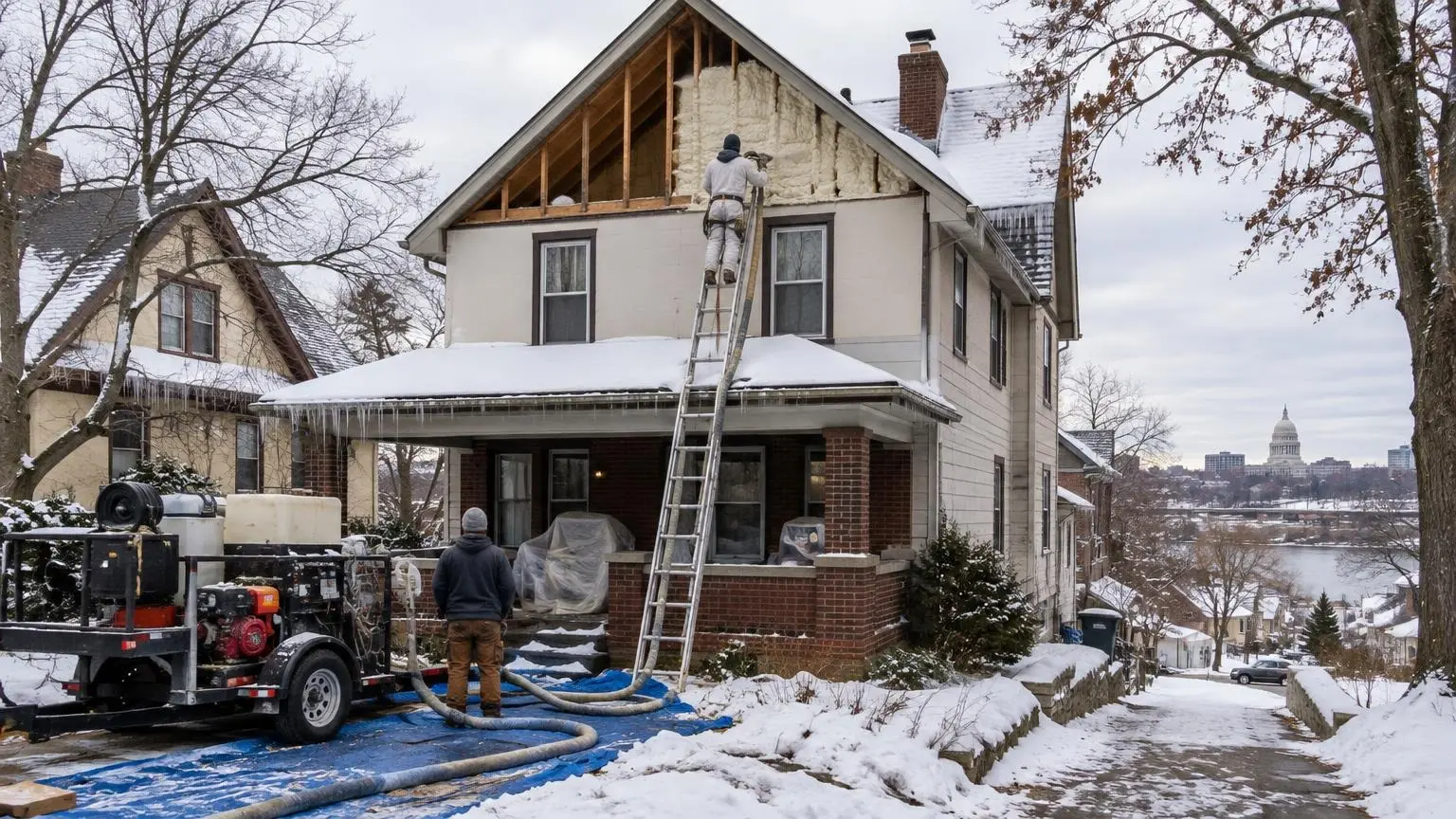
Warm floors start below them
Basement, Rim Joist & Crawl Space Insulation in Lansing, MI
Closed-cell foam where the house meets the foundation.
- Free in-home estimates with measurements
- Itemized written quote: material, thickness and R-value per area
- Leaks, damp spots and old insulation checked before we cover anything
The Leakiest Part of Most Basements
Basement, rim joist and crawl space insulation targets the bottom of the house, where cold air gets in and warm air gets pulled up and out. The rim joist is the wood band that sits on top of the foundation wall around the whole house. It is thin, often uninsulated, and full of gaps where the sill plate meets the concrete. In a Lansing basement, it is usually the first place we spray.
Why the bottom matters
Warm air rises and leaks out the top of a house. That pulls cold outside air in at the bottom, through the rim joist, sill plate and crawl space. Sealing the bottom slows the whole cycle, so upper floors stay warmer and the furnace cycles less. Floors over unheated crawl spaces benefit most.
Closed-cell foam on rims and walls
We use closed-cell foam on rim joists because it seals the gaps, insulates, and resists moisture in one layer. On poured concrete or block foundation walls, closed-cell foam keeps humid indoor air from reaching the cold masonry, which is where condensation and musty smells start. Michigan's 2015-based code lists R-13 cavity or R-10 continuous for basement walls in Zone 5, and R-19 or R-15 continuous for crawl space walls.
Crawl spaces
Many older homes around Lansing sit partly or fully on crawl spaces, or have a crawl under an addition. Vented crawls with fiberglass hanging from the floor joists are common and rarely work well. We often recommend sealing the vents, insulating the crawl walls with closed-cell foam and adding a ground vapor barrier, so the crawl becomes part of the house instead of a cold, damp box under it.
Finishing a basement
If you plan to frame and drywall the basement, insulate first. Foam on the walls and rim before framing costs less and avoids opening new drywall later. Exposed foam in a basement generally needs a thermal barrier such as drywall, so tell us your finishing plans and we will plan around them.
What We Insulate Below the Main Floor
From the rim joist down to the crawl space floor.
Rim joist spray foam
Closed-cell foam around the full perimeter band to seal and insulate in one pass.
Basement wall foam
Closed-cell foam on poured or block walls, ahead of framing or as a stand-alone upgrade.
Crawl space wall insulation
Foam on crawl walls with vents sealed, turning the crawl into conditioned space.
Crawl space vapor barrier
Heavy plastic on the ground, lapped and sealed up the walls to cut ground moisture.
Floors over unheated space
Insulating the floor framing over a cold crawl, porch or garage.

Published Basement, Rim Joist & Crawl Space Costs
| Job | Range and source |
|---|---|
| Rim joists, spray foam | $2,000 to $2,500 (HomeGuide) |
| Closed-cell, installed | $3.00 to $5.00 per sq ft (HomeGuide) |
| Crawl space, spray foam | $2,000 to $4,000 (HomeGuide); $1,000 to $5,900 (Fixr) |
| Crawl space encapsulation | $3 to $10 per sq ft, $3,000 to $15,000 (HomeGuide) |
| Crawl space vapor barrier | $1,200 to $4,000 (HomeGuide) |
| Closed-cell on crawl space walls | $2 to $5 per sq ft (HomeGuide) |
| Crawl space vent sealing | $150 to $450 (HomeGuide) |
Figures are national: Fixr (2025) and HomeGuide's 2026 spray foam and crawl space encapsulation guides. Linear feet of rim, wall height, access and clearing out storage change the total. After measuring, we put your price on a written estimate, and that is the price.
How a Basement or Crawl Job Goes
1. Look and measure
We measure rim length and wall area, check for water, cracks and efflorescence, and note wiring and pipes in the way.
2. Fix water first
Active leaks or grading problems need attention before foam goes on. We tell you what we see.
3. Prep
We clear and mask the work area, cover the floor and ventilate.
4. Spray
Closed-cell foam goes on the rim and walls to the specified thickness.
5. Cover where required
We explain thermal barrier needs so drywall or an approved coating can follow.
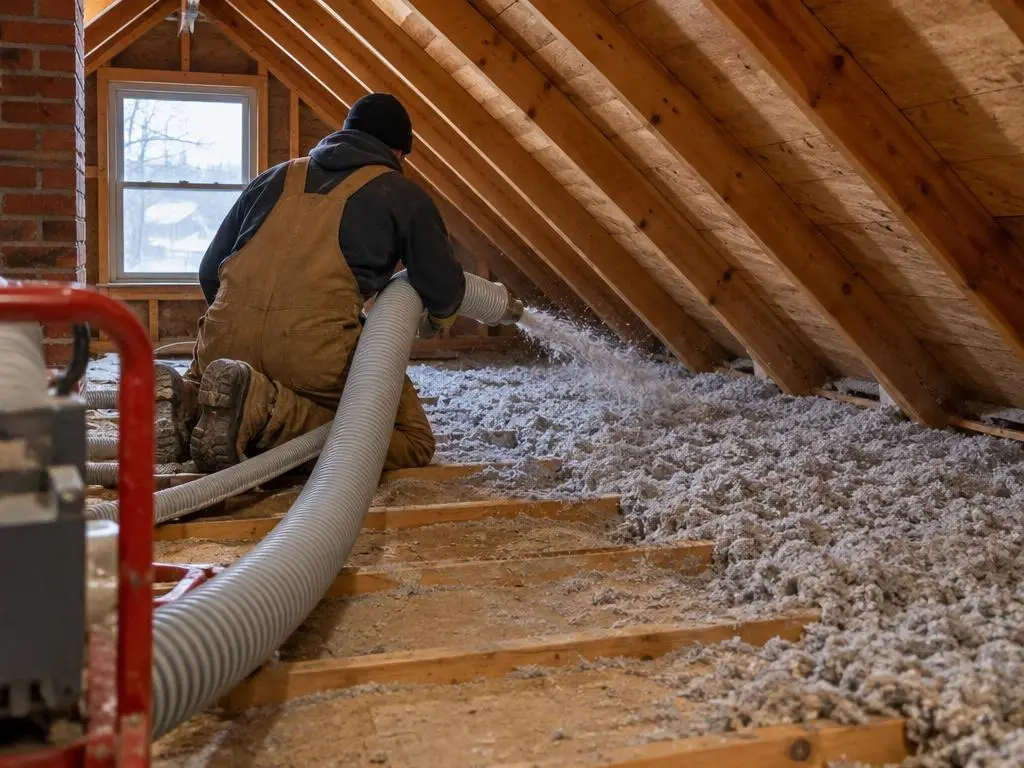
Basement, Rim Joist & Crawl Space Insulation Questions
Is rim joist insulation worth it?
It is one of the cheapest, most noticeable upgrades in an older basement. The rim is thin, exposed to outside air and full of gaps, and sealing it often makes the floor above feel warmer right away.
Should I use foam board or spray foam on the rim joist?
Cut-and-cobbled foam board works if every edge is sealed with canned foam, but it is slow and easy to miss gaps. Closed-cell spray foam seals and insulates in one pass and fills around wires and pipes.
Should I seal my crawl space vents?
Usually yes, if the crawl walls get insulated and the ground gets a vapor barrier, so the crawl stays dry and close to house temperature. Vented crawls with floor insulation tend to stay damp. We check for water and combustion appliances before recommending it.
Can you foam a basement that gets damp?
Foam does not fix water coming through the wall. Leaks, poor grading or missing gutters need to be addressed first. Once the wall is dry, closed-cell foam helps keep it that way by stopping condensation.
Basement, Rim Joist & Crawl Space Insulation Service Areas
- Spray Foam Insulation in Lansing, MI
- Spray Foam Insulation in East Lansing, MI
- Spray Foam Insulation in Okemos, MI
- Spray Foam Insulation in Haslett, MI
- Spray Foam Insulation in Holt, MI
- Spray Foam Insulation in Delta Township, MI
- Spray Foam Insulation in Mason, MI
- Spray Foam Insulation in DeWitt, MI
- Spray Foam Insulation in Grand Ledge, MI
- Spray Foam Insulation in Williamston, MI
- Spray Foam Insulation in Bath Township, MI
- Spray Foam Insulation in Dimondale, MI
- Spray Foam Insulation in Charlotte, MI
- Spray Foam Insulation in St. Johns, MI
- Spray Foam Insulation in Eaton Rapids, MI
- Spray Foam Insulation in Laingsburg, MI
- Spray Foam Insulation in Perry, MI
- Spray Foam Insulation in Portland, MI
- Spray Foam Insulation in Owosso, MI
Get a Basement, Rim Joist & Crawl Space Insulation Estimate
Find out what your basement or crawl space needs and what it costs.