
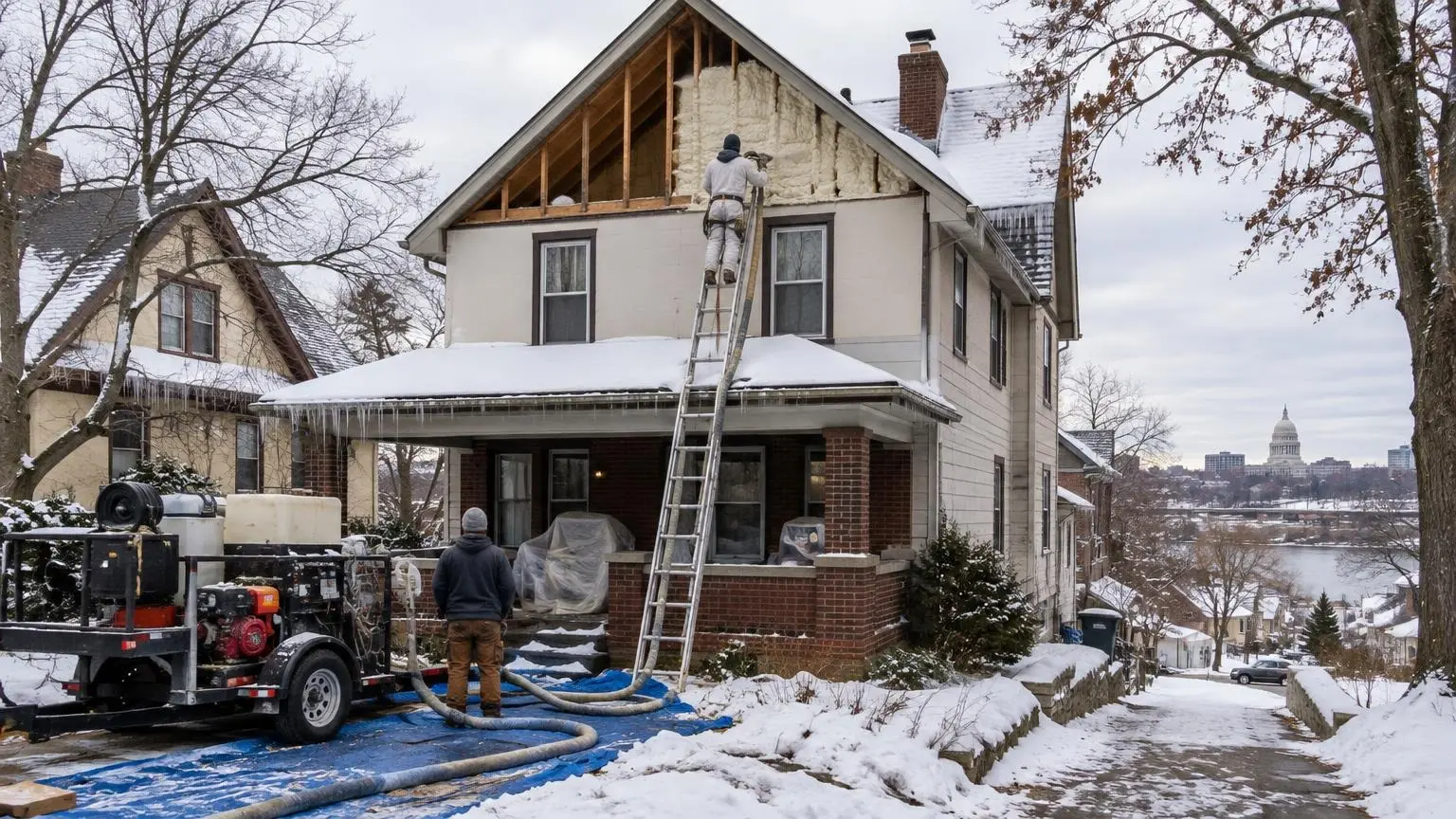
Michigan's capital since 1847
Spray Foam Insulation in Lansing, MI
Half the city's homes predate 1960. Most of them leak.
- Free in-home estimates with measurements
- Itemized written quote: material, thickness and R-value per area
- Leaks, damp spots and old insulation checked before we cover anything
Old Houses, Cold Winters
Spray Foam Insulation in Lansing is mostly about older houses. The city's median home was built in 1959, and close to a quarter of its housing went up in 1939 or earlier, per 2019-2023 Census survey estimates reported by Point2. Neighborhoods around Old Town, REO Town, the Eastside and the near west side are full of two-story frame houses and bungalows with plaster walls, fieldstone or block foundations and attics that were insulated once, decades ago.
What we find in Lansing houses
The pattern repeats. A basement with a bare rim joist you can see daylight through at the sill. Exterior walls with nothing in the cavities. An attic with four or five inches of gray, settled fill and a dozen open holes where wires and pipes come through. Kneewalls in finished half-story rooms with a single batt stapled up and no air barrier behind it. Each of those is fixable, and together they explain why the furnace runs all day in January.
Lansing's winter
The 1991-2020 normals at Capital Region International put the average January day at 23.9 degrees, with about 50 inches of snow a season and a record low of minus 37. Lansing sits inland, away from the heaviest lake-effect bands, but snow still piles on roofs long enough for ice dams to form where warm air leaks into the attic. That is why we seal the attic floor before adding depth.
Owners and landlords
About 54% of Lansing's occupied homes are owner-occupied and 46% are rented. Owners usually call about comfort and heating bills. Landlords call about tenant complaints, frozen pipes along an outside wall, or a rental they are renovating between tenants. Open walls during a renovation are the easiest time to spray foam; closed walls in an occupied house get dense-pack cellulose instead.
Where to start in a Lansing house
If the budget only covers one thing this year, start at the rim joist and the attic floor. Those two areas leak the most air in a typical older Lansing house and cost the least to fix. Walls come next, and only if the cavities turn out to be empty. We open an outlet cover or drill a test hole to check before quoting wall work.
Which utility you have matters
The Lansing Board of Water & Light supplies electricity in the city and lists insulation and air sealing rebates of up to $100 when performance standards are met. Many Lansing homes heat with natural gas from Consumers Energy, whose rebate chart lists separate amounts for attic, wall, basement, crawl space and rim joist insulation. Check both before the work starts so the paperwork is in order. Get a free estimate
What to Know in Lansing
- Housing age. Lansing's median home was built in 1959; 24.5% of homes date from 1939 or earlier and about 51% from before 1960 (2019-2023 ACS via Point2).
- Winter climate. At Capital Region International, January averages 23.9 F, seasonal snowfall averages about 50 inches, and the record low is -37 F (1991-2020 normals, Wikipedia).
- Owners and renters. Of about 51,600 occupied homes, 53.8% are owner-occupied and 46.2% rented (2019-2023 ACS via Point2).
- Climate zone. Ingham County is in Climate Zone 5A (OpenEI), where Michigan's 2015-based code calls for R-38 ceilings and ENERGY STAR suggests R-60 for an uninsulated attic.
- Utility rebates. BWL, which serves Lansing, lists insulation and air sealing rebates of up to $100 when performance standards are met.
Lansing Questions
Is spray foam a good idea for an old Lansing house?
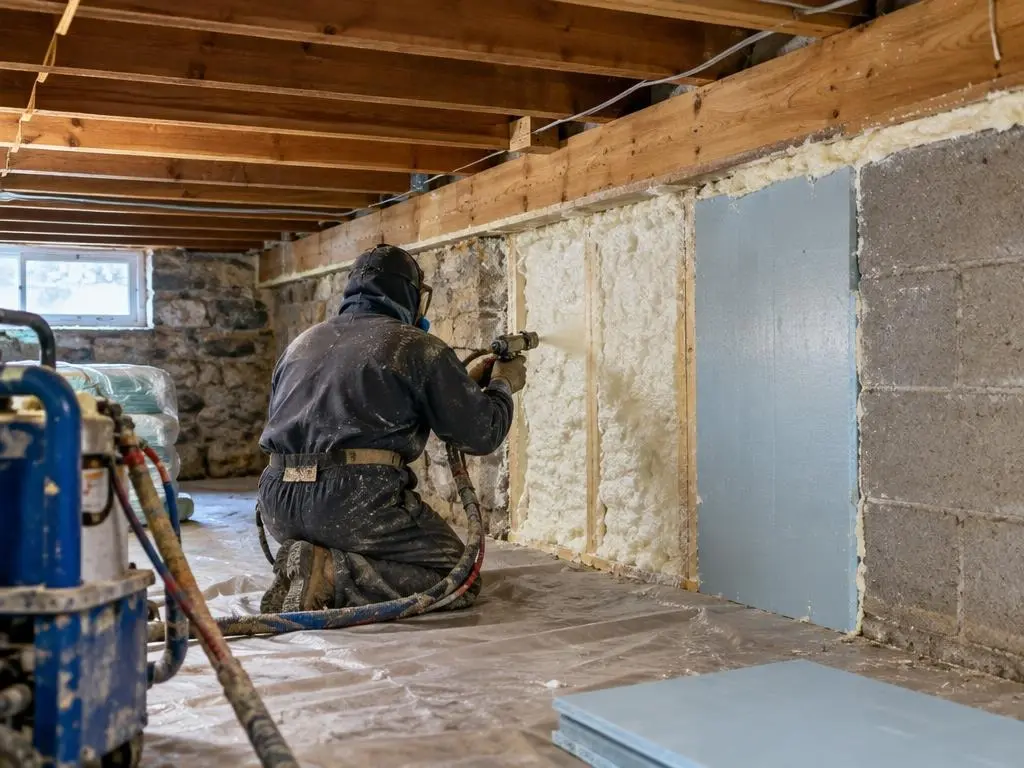
In the right places. Closed-cell foam on the rim joist and in an open kneewall or cathedral ceiling makes a big difference. Closed plaster walls are better filled with dense-pack cellulose, and open attic floors are often best sealed and then blown with cellulose.
My Lansing house has a fieldstone foundation. Can you foam it?
Often yes, once any water problems are handled. Closed-cell foam follows the uneven stone and seals the gaps. We look at moisture first, since foam will not stop water coming through the wall.
Do BWL rebates cover spray foam?
BWL lists insulation and air sealing rebates of up to $100 when performance standards are met. Check BWL's current terms for which materials and documentation qualify.
What about knob-and-tube wiring?
Many older Lansing homes still have some. We check for it before quoting wall or attic work, and active knob-and-tube should be evaluated by an electrician before insulation surrounds it.
How long does a typical Lansing job take?
A rim joist or attic job is usually one day. Whole-house wall insulation can take two or three days depending on the number of stud bays and how much siding has to be lifted.
Do you work in REO Town, Old Town and the Eastside?
Yes, across the whole city. Older neighborhoods are where most of our wall and attic sealing work happens.
Free Estimates in Lansing, MI
Lansing homeowners and landlords: request a free estimate.
Spray Foam Insulation Near Lansing
- Spray Foam Insulation in East Lansing, MI
- Spray Foam Insulation in Okemos, MI
- Spray Foam Insulation in Haslett, MI
- Spray Foam Insulation in Holt, MI
- Spray Foam Insulation in Delta Township, MI
- Spray Foam Insulation in Mason, MI
- Spray Foam Insulation in DeWitt, MI
- Spray Foam Insulation in Grand Ledge, MI
- Spray Foam Insulation in Williamston, MI
- Spray Foam Insulation in Bath Township, MI
- Spray Foam Insulation in Dimondale, MI
- Spray Foam Insulation in Charlotte, MI
- Spray Foam Insulation in St. Johns, MI
- Spray Foam Insulation in Eaton Rapids, MI
- Spray Foam Insulation in Laingsburg, MI
- Spray Foam Insulation in Perry, MI
- Spray Foam Insulation in Portland, MI
- Spray Foam Insulation in Owosso, MI