
The Island City
Spray Foam Insulation in Eaton Rapids, MI
Some of the oldest housing in the area.
- Free in-home estimates with measurements
- Itemized written quote: material, thickness and R-value per area
- Leaks, damp spots and old insulation checked before we cover anything
Old Houses in the Island City
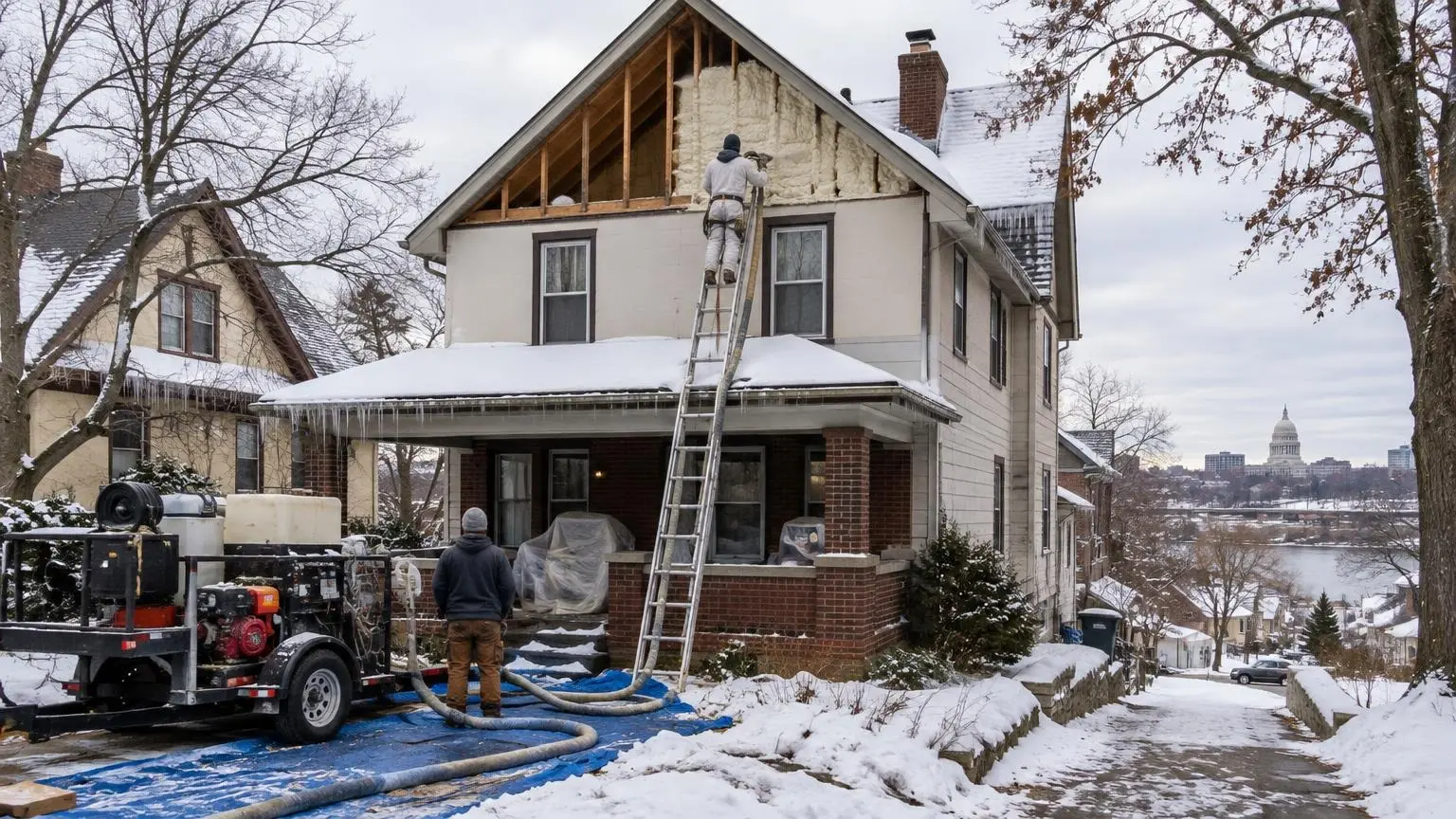
Spray Foam Insulation in Eaton Rapids deals with some of the oldest homes in the Lansing area. The city's median home was built in 1954, and more than 43% of its housing dates from 1939 or earlier. Eaton Rapids grew up around timber and water power in the 1830s, then boomed after 1869 as a mineral-springs health resort nicknamed the Saratoga of the West. Its downtown sits on an island in the Grand River.
What old Eaton Rapids homes need
The typical house from that era has plaster walls with empty or partly filled cavities, an attic with a thin layer of old fill, and a stone or block foundation with an open rim joist. We usually work bottom to top: rim joist foam, attic floor sealing and new attic depth, then dense-pack cellulose in the walls once wiring and moisture have been checked.
River and basements
With the Grand River and Spring Brook running through town, damp basements are common close to the water. Foam does not stop water coming through a wall, so we look at grading, gutters and any seepage first.
Mansions and big old houses
Larger old homes, like the 1927 Tudor Revival Medovue built by Oldsmobile president Irving Reuter, come with steep roofs, finished attics and complicated kneewalls. Spray foam on sloped ceilings and kneewalls is often the only practical way to insulate those spaces without removing finishes.
Where to start
If you can only do one thing this year in an older Eaton Rapids house, seal and foam the rim joist. It is usually the least expensive job and makes the floors above warmer right away. The attic is next.
Wells, springs and damp ground
Eaton Rapids was known for its artesian mineral wells, at least fourteen of them drilled after 1869. High groundwater near the river and springs is one reason we check basements carefully before insulating. A dry basement wall can take closed-cell foam directly; a wet one needs drainage work first.
Owners
About 70% of Eaton Rapids' occupied homes are owner-occupied. The city's 2,364 housing units had a 7.4% vacancy rate in 2020. Get a free estimate
Eaton Rapids Facts
- Housing age. 43.5% of Eaton Rapids homes date from 1939 or earlier; the median home was built in 1954 (2019-2023 ACS via Point2).
- History. The first mineral water well was drilled around 1869, and the city became a health resort called the Saratoga of the West (Wikipedia).
- Island downtown. Downtown sits on an island in the Grand River formed by a canal dug in the 1840s (Wikipedia).
- Housing. The 2020 census counted 2,364 housing units, 7.4% vacant (Wikipedia).

Eaton Rapids Questions
My Eaton Rapids house is over 100 years old. Where do I start?
With the rim joist and attic floor, since those leaks are cheap to fix and make a quick difference. Walls come next if they are empty and the wiring is sound.
Can you insulate a finished attic room with sloped ceilings?
Yes. Foam on the sloped ceilings and kneewalls, or dense-pack in closed slopes, depending on access. We look first.
Will insulating the walls trap moisture in my old house?
Not in a sound wall. Dense-pack cellulose handles moisture well. Leaky gutters, flashing or siding need fixing first, or any insulation will get wet.
How much does dense-pack wall insulation cost?
National guides put dense-pack cellulose at about $1.60 to $4.20 per square foot. We count your stud bays and quote in writing.
Do you serve the area outside Eaton Rapids?
Yes, including the townships and farms around the city.
Free Estimates in Eaton Rapids, MI
Eaton Rapids homeowners: request a free estimate.
Spray Foam Insulation Near Eaton Rapids
- Spray Foam Insulation in Lansing, MI
- Spray Foam Insulation in East Lansing, MI
- Spray Foam Insulation in Okemos, MI
- Spray Foam Insulation in Haslett, MI
- Spray Foam Insulation in Holt, MI
- Spray Foam Insulation in Delta Township, MI
- Spray Foam Insulation in Mason, MI
- Spray Foam Insulation in DeWitt, MI
- Spray Foam Insulation in Grand Ledge, MI
- Spray Foam Insulation in Williamston, MI
- Spray Foam Insulation in Bath Township, MI
- Spray Foam Insulation in Dimondale, MI
- Spray Foam Insulation in Charlotte, MI
- Spray Foam Insulation in St. Johns, MI
- Spray Foam Insulation in Laingsburg, MI
- Spray Foam Insulation in Perry, MI
- Spray Foam Insulation in Portland, MI
- Spray Foam Insulation in Owosso, MI