
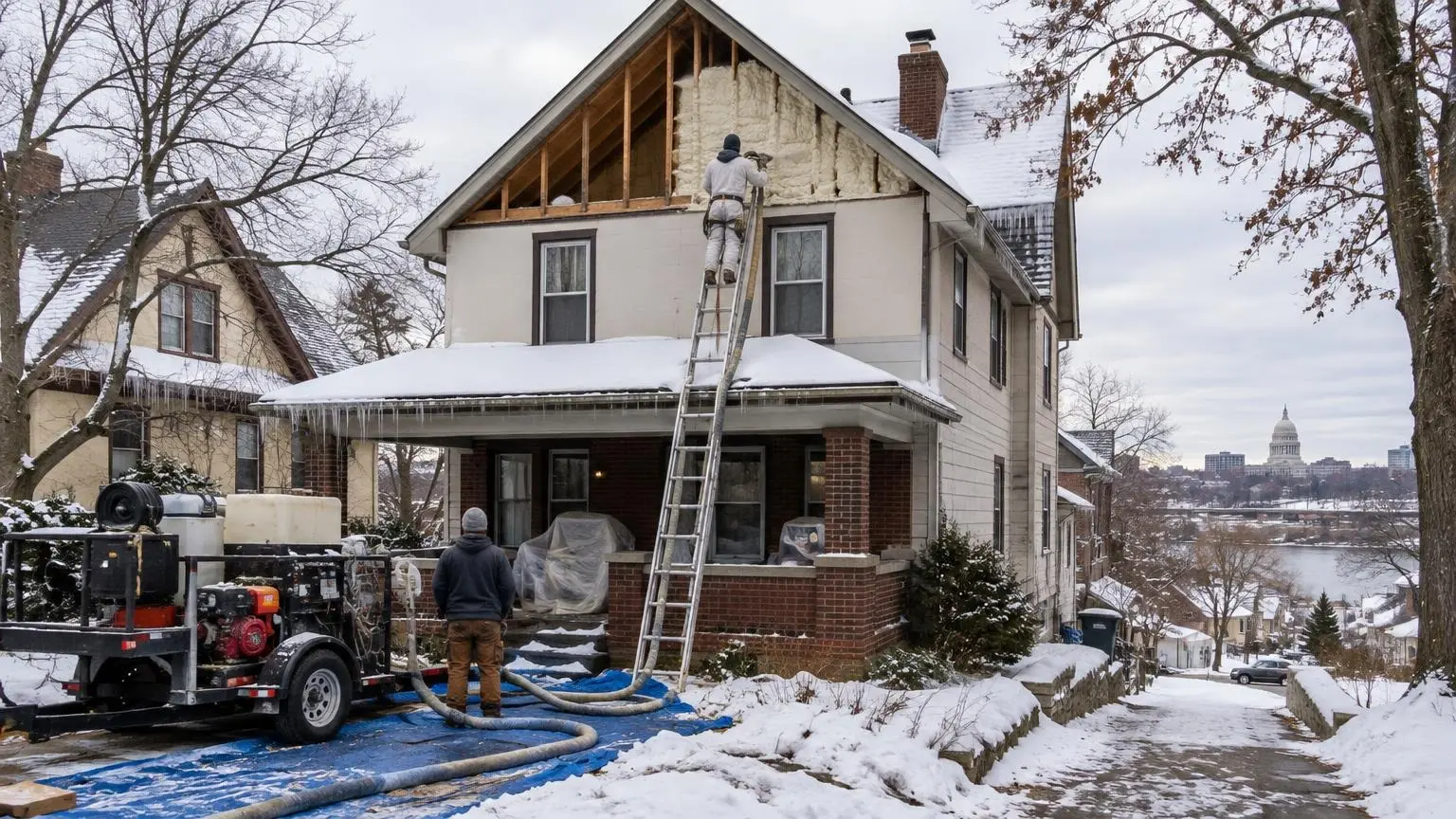
Mid-Michigan winters, older houses
Spray Foam Insulation in Lansing, MI
Air sealing and insulation for Capital Region homes, garages and pole barns, quoted in writing.
- Free in-home estimates with measurements
- Itemized written quote: material, thickness and R-value per area
- Leaks, damp spots and old insulation checked before we cover anything
Warmer Rooms, Fewer Drafts, Lower Heating Bills
Spray Foam Insulation Lansing seals and insulates homes in Lansing and the surrounding Capital Region, from century-old houses near Old Town to newer subdivisions in Holt and Okemos. If you are looking for spray foam insulation in Lansing because the upstairs is cold, the floors are freezing or the furnace never shuts off, the fix usually starts with finding where the air leaks out. We do that first, then insulate.
Why Lansing houses lose heat
Lansing's housing is old. About half of the city's homes were built before 1960, and roughly one in four went up in 1939 or earlier, according to 2019-2023 Census survey estimates. Those houses were framed with little or no wall insulation, balloon-framed walls that let air run from basement to attic, and rim joists that were never sealed. Many were insulated decades ago with a few inches of fiberglass or loose fill that has since settled. Add a January that averages about 24 degrees and roughly 50 inches of snow a season, and the gaps show up as ice dams, cold rooms and high bills.
Closed cell vs open cell foam
Closed-cell foam is dense and rigid. It adds roughly R-6 or more per inch, blocks air, resists moisture and stiffens what it sticks to, which makes it the usual choice for rim joists, basement walls, crawl space walls and steel buildings. Open-cell foam is softer and lighter, around R-3.5 to R-4 per inch, seals air well and costs less per inch, so it fits roof decks and interior walls where moisture is not a concern. We pick the foam for the surface, not the other way around, and on many attic floors we recommend sealing with foam and then blowing cellulose to depth.
What spray foam insulation costs
National cost guides put installed spray foam at about $1.50 to $5.00 per square foot, with open cell at the low end and closed cell at the high end (HomeGuide). A rim joist job often lands around $2,000 to $2,500, and an average attic insulation project runs about $1,000 to $2,700. Each service page has a full table with sources. Your price comes from measuring your house, and the written estimate is what you pay.
Choosing among spray foam insulation contractors
When you compare spray foam insulation companies or insulation contractors near you, ask each one the same questions. Will they inspect before quoting? Does the quote list the foam type, thickness and R-value for each area? How do they handle the attic hatch, can lights and bath fans? How long should you stay out of the house after spraying? What do they do about ignition and thermal barriers in garages and basements? We answer all of those in writing.
Codes and rebates in the Lansing area
Ingham, Eaton and Clinton counties sit in Climate Zone 5A. Michigan's residential energy code built on the 2015 IECC calls for R-38 ceilings and R-20 walls (or R-13 plus R-5 continuous) for new work in this zone, and ENERGY STAR suggests R-60 for an uninsulated attic here. A 2021-based update that would raise ceilings to R-60 was paused by the Michigan Court of Claims in July 2025, so ask your building department which edition applies to a permitted project. On the rebate side, Consumers Energy's insulation rebate chart lists amounts for attic, wall, basement, crawl space and rim joist work, and the Lansing Board of Water & Light lists insulation and air sealing rebates of up to $100 when performance standards are met. Programs change, so check before you sign. Get a free estimate
Our Services
Six services, each matched to what mid-Michigan houses and outbuildings actually need.
Spray Foam Insulation
Closed-cell and open-cell foam that insulates and air seals in one pass.
Learn more →Attic Air Sealing & Insulation
Seal the leaks in the attic floor, then bring the insulation up to depth.
Learn more →Basement, Rim Joist & Crawl Space Insulation
Seal the rim joist and insulate foundation walls to warm the floors above.
Learn more →Pole Barn & Garage Insulation
Closed-cell foam that insulates steel buildings and stops condensation drip.
Learn more →Insulation Removal & Replacement
Out with wet, soiled or failing insulation, in with a sealed, insulated attic or crawl.
Learn more →
Why Homeowners Call Spray Foam Insulation Lansing
We look before we quote
Every estimate follows a visit where we measure the attic, basement or crawl space and check existing insulation depth and condition.
The right material for each surface
Closed cell where moisture or strength matters, open cell where it does not, and blown-in cellulose where loose fill is the better value.
Air sealing comes first
Rim joists, top plates, chases and attic hatches get sealed before new insulation goes over them, because insulation alone does not stop drafts.
Quotes you can compare
Each area is listed with its material, thickness, target R-value and price, so you can line our quote up against any other.
Common Questions
How much does spray foam insulation cost in Lansing?
National guides put installed spray foam at about $1.50 to $5.00 per square foot, with closed cell costing more than open cell, and many companies have a job minimum of $1,000 to $2,000. What you pay depends on the area, foam type, thickness and prep. We measure and give you a written price.
Can you spray foam inside existing walls?
Not with standard open or closed-cell foam, which expands too fast and can bow drywall or plaster. Closed walls are usually filled with dense-pack cellulose through small holes, or with an injection foam made for that purpose. Open walls during a remodel can take spray foam directly.
Is closed cell or open cell better for a Michigan basement?
For rim joists and below-grade walls, closed cell is the usual choice because it resists moisture and acts as its own vapor retarder at about 2 inches. Open cell can trap moisture against cold concrete. Basement foam also needs a covering such as drywall where code requires a thermal barrier.
How long do I need to stay out of the house after spraying?
Plan on staying out of the spray area during the work and for about 24 hours after, and longer if the manufacturer's instructions call for it. We ventilate the space and tell you when it is safe to return.
What R-value does Michigan require for attics?
The 2015-based Michigan energy code calls for R-38 ceilings in Climate Zone 5, which includes the Lansing area. ENERGY STAR recommends R-60 for an uninsulated attic and R-49 when you are adding to 3 to 4 inches already there. A 2021-based code update with R-60 ceilings has been paused in court, so check with your building department.
Are there rebates for insulation in Lansing?
Consumers Energy publishes an insulation rebate chart covering attics, walls, basements, crawl spaces and rim joists, with a December 31 application deadline for the listed amounts. The Lansing Board of Water & Light lists insulation and air sealing rebates of up to $100 when performance standards are met. Confirm the current terms with your utility before work starts.
Where We Work
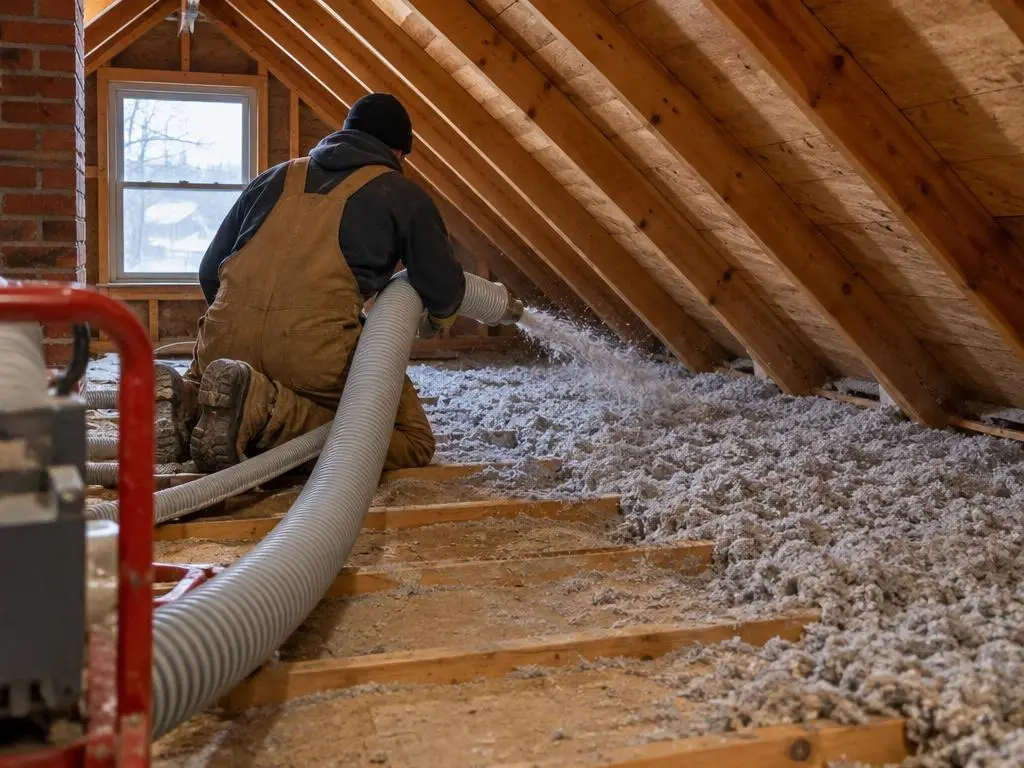
We work across the Lansing area: Lansing, East Lansing, Okemos, Haslett, Holt, Delta Township and Mason in the core, plus DeWitt, Bath Township and St. Johns to the north, Grand Ledge, Dimondale, Charlotte and Eaton Rapids to the west and south, Williamston to the east, and Laingsburg, Perry, Owosso and Portland further out.
The work changes with the town. Eaton Rapids, Owosso, Portland and Laingsburg have some of the oldest housing in the region, with a third or more of homes built before 1940, so wall cavities, stone or block foundations and old attic fill are common. Holt, Okemos and DeWitt are newer, with basements to finish and bonus rooms over garages. Rural Clinton and Eaton counties bring pole barns and shops. Each town page lists what we found about that town's housing and climate, with sources.
- Spray Foam Insulation in Lansing, MI
- Spray Foam Insulation in East Lansing, MI
- Spray Foam Insulation in Okemos, MI
- Spray Foam Insulation in Haslett, MI
- Spray Foam Insulation in Holt, MI
- Spray Foam Insulation in Delta Township, MI
- Spray Foam Insulation in Mason, MI
- Spray Foam Insulation in DeWitt, MI
- Spray Foam Insulation in Grand Ledge, MI
- Spray Foam Insulation in Williamston, MI
- Spray Foam Insulation in Bath Township, MI
- Spray Foam Insulation in Dimondale, MI
- Spray Foam Insulation in Charlotte, MI
- Spray Foam Insulation in St. Johns, MI
- Spray Foam Insulation in Eaton Rapids, MI
- Spray Foam Insulation in Laingsburg, MI
- Spray Foam Insulation in Perry, MI
- Spray Foam Insulation in Portland, MI
- Spray Foam Insulation in Owosso, MI
Get a Spray Foam Insulation Estimate
Tell us what feels cold. We will measure, explain the options and put the price in writing.