
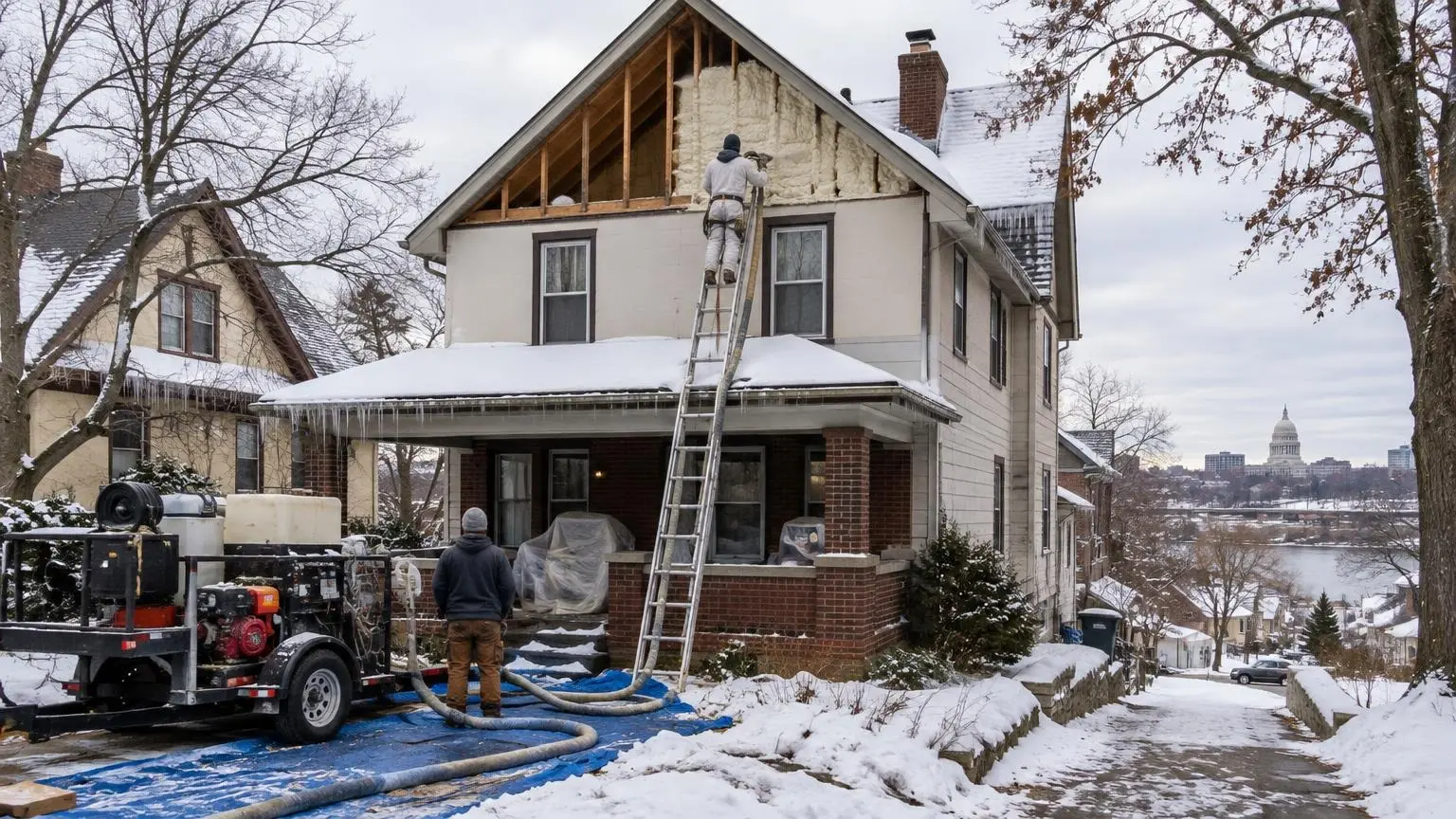
Insulation and air seal together
Spray Foam Insulation in Lansing, MI
Closed cell where moisture matters, open cell where it does not.
- Free in-home estimates with measurements
- Itemized written quote: material, thickness and R-value per area
- Leaks, damp spots and old insulation checked before we cover anything
What Spray Foam Does That Batts Cannot
Spray Foam Insulation goes on as a liquid and expands to fill the cavity, so it stops air movement as well as slowing heat loss. That matters in Lansing-area homes, where much of the heat lost in winter leaks out through gaps rather than through the insulation itself. Fiberglass batts slow heat but let air pass straight through; foam closes the path.
Closed cell vs open cell
Closed-cell foam is dense, about 2 pounds per cubic foot, and adds roughly R-6 to R-7 per inch. It blocks air and water vapor and adds stiffness to the wall or roof it bonds to. We use it on rim joists, basement and crawl space walls, pole barn steel, and anywhere condensation is a risk.
Open-cell foam is lighter, around half a pound per cubic foot, and gives about R-3.5 to R-4 per inch. It seals air and fills odd shapes well and costs less per inch, but it lets moisture vapor through. It suits roof decks in conditioned attics, interior walls for sound and cathedral ceilings where a vapor retarder is handled separately.
Who needs it
You are a good candidate if you have a rim joist you can see from the basement, a room over the garage that never warms up, a cathedral ceiling with no room for loose fill, a basement you are about to finish, or a metal building that drips in spring. If your main problem is a thin layer of old fill on an open attic floor, foam may not be the cheapest fix. We will tell you so.
How to tell
Cold floors over a garage or crawl space, drafts at baseboards, frost or rust on nails in the attic, ice dams along the eaves, and a furnace that runs constantly in January all point to air leaks. We find them with a walk-through and, where useful, a smoke pencil or infrared camera.
Where We Spray Foam
The surfaces where foam does the most good in mid-Michigan houses and buildings.
Rim joists and band boards
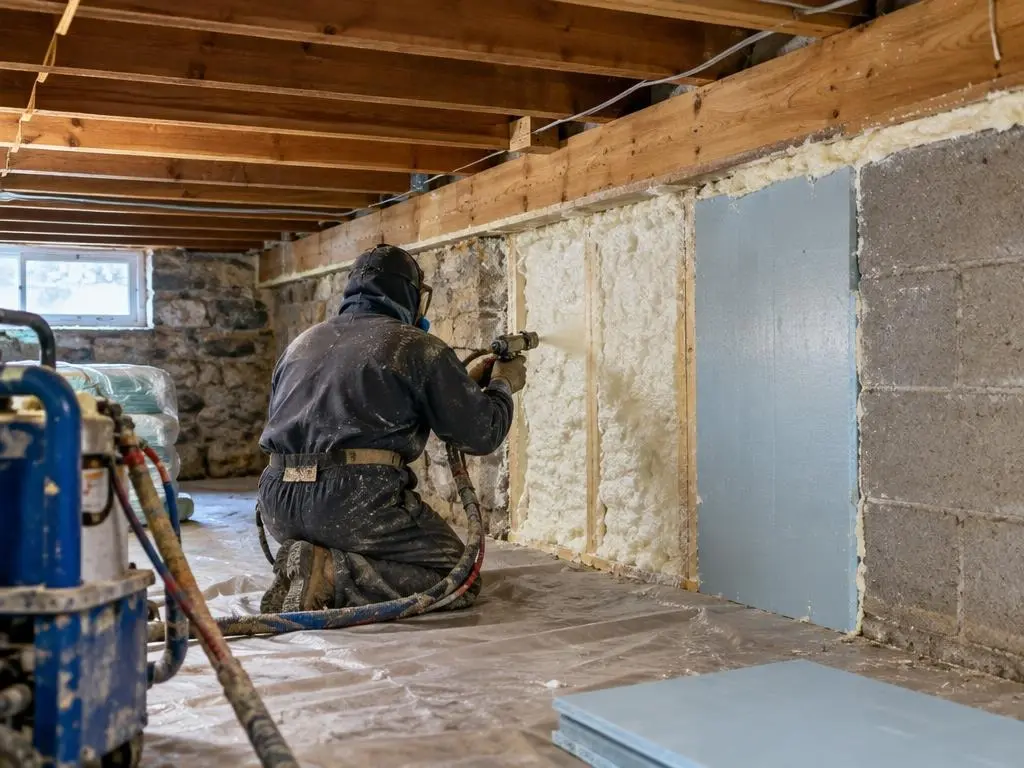
Closed-cell foam on the wood where the floor framing meets the foundation, one of the leakiest spots in most basements.
Basement and crawl space walls
Closed-cell foam on concrete or block walls to stop air and keep warm indoor air off cold masonry.
Roof decks and cathedral ceilings
Open or closed-cell foam on the underside of the roof to make a conditioned attic or insulate a vaulted ceiling.
Garage ceilings and bonus room floors
Foam in the floor framing over a garage to warm the room above and seal out exhaust.
Open walls during remodels
Foam in exposed stud bays when drywall or plaster is off, for new additions or gut renovations.
Pole barns and steel buildings
Closed-cell foam on steel panels and framing to insulate and stop condensation drip.
Published Spray Foam Insulation Costs
| Job | Range and source |
|---|---|
| Spray foam, installed | $1.50 to $5.00 per sq ft (HomeGuide) |
| Open-cell / closed-cell | $1.50 to $3.50 / $3.00 to $5.00 per sq ft (HomeGuide) |
| About 1,000 sq ft | $1,500 to $5,000 (HomeGuide); $3,150 to $7,500 existing home (Fixr) |
| Existing walls / new construction | $3.15 to $7.50 / $2.75 to $6.50 per sq ft (Fixr) |
| All exterior walls | $4,000 to $10,000 (HomeGuide) |
| Whole house | $8,000 to $20,000 (HomeGuide); $10,000 to $30,000 (Fixr) |
| Typical job minimum | $1,000 to $2,000+ (HomeGuide) |
National ranges from HomeGuide's 2026 spray foam guide and Fixr (2025). Thickness, foam type, prep and access all move the number, and small jobs often hit a minimum. We price your project after measuring it, and that written estimate is the amount you pay.
How a Spray Foam Job Goes
1. Inspect and measure
We look at each area, measure square footage and depth, and check for moisture, wiring and anything that needs fixing first.
2. Written estimate
You get a quote listing foam type, thickness, R-value and price for each area.
3. Prep the space
We mask, cover floors and belongings, shut down air handlers if needed and set up ventilation.
4. Spray and trim
Foam goes on in passes to the specified thickness; we trim where needed and clean up.
5. Re-entry and walkthrough
After the re-entry period we walk the job with you and check thickness and coverage.

Spray Foam Insulation Questions
Is spray foam worth it in Michigan?
It pays off most where air leakage is high and space is tight: rim joists, cathedral ceilings, rooms over garages, basement walls and metal buildings. On an open attic floor, sealing gaps and blowing in cellulose often gives similar comfort for less. We will tell you which applies to your house.
Does spray foam need a vapor barrier?
Closed-cell foam at about 2 inches or more acts as its own vapor retarder, so it usually does not need a separate sheet. Open-cell foam is vapor-permeable, so in cold climates it may need a vapor retarder coating on the warm side depending on where it is used.
Can spray foam go over old insulation?
No. Foam has to bond to clean, dry framing or sheathing. Old batts or loose fill in the way come out first, which is why removal is sometimes part of a foam quote.
What temperature does it have to be to spray?
Each product lists a minimum surface and air temperature, and winter work in unheated attics, garages or pole barns sometimes needs temporary heat. We plan the date around it.
Does spray foam need to be covered?
In living spaces, basements and garages, codes generally require foam to be covered with an approved thermal barrier such as drywall, or use a product rated for exposure. Attics and crawl spaces have their own rules. We explain what applies before we start.
Spray Foam Insulation Service Areas
- Spray Foam Insulation in Lansing, MI
- Spray Foam Insulation in East Lansing, MI
- Spray Foam Insulation in Okemos, MI
- Spray Foam Insulation in Haslett, MI
- Spray Foam Insulation in Holt, MI
- Spray Foam Insulation in Delta Township, MI
- Spray Foam Insulation in Mason, MI
- Spray Foam Insulation in DeWitt, MI
- Spray Foam Insulation in Grand Ledge, MI
- Spray Foam Insulation in Williamston, MI
- Spray Foam Insulation in Bath Township, MI
- Spray Foam Insulation in Dimondale, MI
- Spray Foam Insulation in Charlotte, MI
- Spray Foam Insulation in St. Johns, MI
- Spray Foam Insulation in Eaton Rapids, MI
- Spray Foam Insulation in Laingsburg, MI
- Spray Foam Insulation in Perry, MI
- Spray Foam Insulation in Portland, MI
- Spray Foam Insulation in Owosso, MI
Get a Spray Foam Insulation Estimate
Find out which foam fits your house and what it costs, in writing.